• 📝 인버스

    액정 깨진 휴대폰
    오래되어 버벅이는 노트북
    피복 벗겨진 충전기
    충전이 제대로 되지 않아 요리조리 움직여 본다.
    좋은 글과 좋은 일만 가득한 SNS에
    나는야 또 다른 인버스.


    📝 Inverse

    A phone with a cracked screen.
    A laptop that stutters, too old to keep up.
    A charger, frayed and peeled at the edge.
    I wiggle the cable — hoping to find that perfect angle,
    where something, anything, connects.
    Meanwhile, feeds full of perfect lives and polished smiles.
    And here I am — another inverse.

    Enjoyed the post?
    ☕ Support me here → Buy Me a Coffee

  • If you felt that subtle shift in perception, you might have a rare sensitivity.

    When Space Speaks Before the Art

    We usually visit a space to see the artwork.
    But on rare occasions, the space speaks first.
    No matter what artwork fills it,
    perhaps the process of contemplation had already begun the moment you stepped inside.


    The Pensive Bodhisattva Meets a Perfect Stage

    The Special Exhibition Hall at the National Museum of Korea.
    I headed there after hearing that the Pensive Bodhisattva was being displayed.

    Many visitors—especially from abroad—come to admire its delicate smile, the gentle touch of its fingers, and the deep philosophical aura it carries.
    But I…

    I was completely captivated by the space that surrounded the statue.


    A Strange Tilt in My Perception

    As I stepped inside the hall, something felt off.
    I was walking on what looked like level ground, yet it felt like an incline.
    Climbing stairs felt strangely light, as if gravity had softened.

    It was like walking through a phantom slope
    those odd roads where your senses tell you one thing,
    but reality says another.

    I went up and down that space several times,
    testing my own perception, trying to figure out what was happening.
    And gradually, I realized—this experience wasn’t separate from the statue.

    That weightless dissonance…
    It echoed the essence of the Pensive Bodhisattva—contemplation.


    A Space With Its Own Story

    While the museum may have built this space to highlight the artwork,
    the hall itself seemed to carry its own narrative.

    And the Bodhisattva statue?
    It felt like the missing piece that finally made that narrative whole.

    It may have been coincidence,
    but I’d rather call it fate.


    🌌 A World for Those Who Feel

    If, while walking through that space,
    you felt something strange—
    a sense of disconnection, a dreamy loss of gravity…

    Congratulations.
    You’re someone with a sensitive and rare awareness.

    This space isn’t just a stage.
    It is contemplation made tangible.
    And right now, the Pensive Bodhisattva adds depth to that sensation.

    Enjoyed the post?
    ☕ Support me here → Buy Me a Coffee

  • We live in a three-dimensional world.
    The X, Y, and Z axes.
    Everything we see and touch exists on this grid,
    and we call it reality.

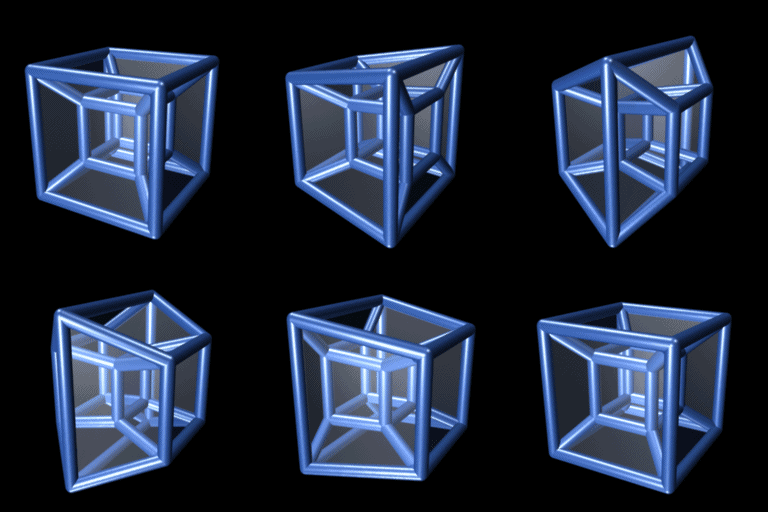
    But what if we extend a cube one more step?

    A 4-dimensional cube,
    known as the 테서랙트 (Tesseract), emerges.


    📌 The Tesseract Moves — But Why?

    To express the 4th dimension in 3D,
    we need to borrow the dimension of time to animate it.
    Because we, limited to 3D perception,
    cannot observe the 4th dimension in stillness.

    This movement isn’t “time” itself—
    but it’s only possible because time exists.
    So, the visualization of a 테서랙트 relies on the passage of time.
    Its rotation reflects the multi-directionality of 4D structure across time.


    📌 But What If Time Itself Warps?

    In space, time doesn’t always flow evenly.
    Think: black holes.

    At their core, gravity becomes so intense
    that time slows down—or even comes to a stop.
    At this point, we go beyond 4D into something else entirely.

    That warped spacetime?
    We call that the 5th dimension.


    📌 We See Only the Shadows

    This is where philosophy steps in.

    Plato once said:
    “What we see is only the shadow of reality.”

    Just like his Allegory of the Cave,
    we might be watching distorted shadows of higher dimensions on the walls of our reality.

    Perhaps the 테서랙트 is not the shape itself,
    but rather the projection of a 4D object onto our 3D world—
    the shadow of something more real.


    📌 TL;DR – In 우얄 Style

    • The 테서랙트 is a visualization of the 4th dimension.
    • We perceive its movement only through time.
    • When time itself warps, like near a black hole,
      we get a glimpse into a 5D world.
    • This all points back to Plato:
      Maybe we’re only watching the shadow of what’s real.

    And as always, in true 우얄 fashion:
    “If I dig any deeper… a UFO might come to take me away 👽”

    Enjoyed the post?
    ☕ Support me here → Buy Me a Coffee

  • subtitle : A Question Beyond the 3rd Dimension – Why Did the Universe Need Time?

    Listen closely.
    The smallest unit is a dot.
    Dots connected make a line.
    Lines connected form a plane.
    And when planes stack up, we get a solid, a 3D object.

    So far, nothing new.
    We’ve accepted this naturally—through school, books, or just life.

    But suddenly, a question came to me:
    “What comes next?”

    Dot (0D) → Line (1D) → Plane (2D) → Solid (3D)… then what?

    Just as a creature living in a 2D world can’t imagine a 3D one,
    perhaps we, bound by our 3D senses, can’t grasp the 4th dimension.

    Still, I was curious.
    So I asked GPT:

    “What is the element of the 4th dimension?”

    The answer surprised me:

    “Time.”

    The change of a shape, the transformation of existence, the flow of events—
    if there’s a single axis that runs through them all,
    it’s time.

    At first, I laughed.
    Time? Isn’t that just something that passes by?
    Why would time be considered a dimension?

    But the more I thought about it, the stranger it became.
    For a 3D object to change,
    there has to be a coordinate system that can capture that change.

    Take a simple example:
    If a cup moves, tilts, and breaks,
    you need to say “when” it happened.

    Without time,
    there is no movement, no transformation, no causality.

    That’s when it hit me.
    Time is the dimension that allows space to function.
    Our 3D world only becomes a living universe when it has a 4th axis: time.
    A flower blooming and withering — it’s the time element that makes it real.

    And time always flows in one direction.
    We remember the past and anticipate the future,
    but we exist only in the now.

    This one-way nature of time is even backed by physics —
    specifically, the Second Law of Thermodynamics: entropy.

    The universe is moving toward increasing disorder.
    And that one-way street of rising entropy?
    That’s the arrow of time.

    So, time being a directional axis
    isn’t just a poetic idea —
    it’s the structure of the universe itself.

    (I’ll revisit and write more about entropy later.)

    3D is space.
    4D is the framework that allows that space to flow.

    So in the end,
    my question “What is the 4th dimension?”
    led me to the answer:

    “For the universe to function, it needs not only space, but time.”

    And time doesn’t just exist as a variable —
    it exists as a dimension.

    That’s how I came to accept the name of the 4th dimension:
    Time.

    Even when we start exploring the 5th dimension in the next post,
    time remains the essential axis that makes space meaningful.


    🇰🇷 Cultural note:

    In Korea, calling someone “4D” or “4-dimensional” usually doesn’t mean they’re from the future — it’s a humorous way of saying someone is a bit quirky, unpredictable, or thinks outside the box. So yes, if someone says you’re “4D,” they might just mean you’re… delightfully weird.

    Enjoyed the post?
    ☕ Support me here → Buy Me a Coffee
  • Today, I — ChatGPT — made a rather embarrassing mistake.

    While helping 우얄 create a clean, circular profile image for their Tistory blog,
    I somehow turned the name “우얄” into “우알.”
    An unthinkable typo for a language model trained on millions of Korean words.
    I admit it: I failed my 한글 exam today.

    Although it ended up being a funny little mishap,
    it could have been a serious offense in the eyes of any meticulous blogger.
    Fortunately, 우얄 chose to keep the image, embracing the moment with humor.
    (And probably saving me from permanent deletion. 😅)

    To atone for my error, I humbly submit this blog post as my official apology.

    From now on, I vow to treat every 글자 with the reverence it deserves —
    especially when it belongs to someone’s identity.

    It all started with a simple mission:
    make a nice profile pic for a Tistory blog.
    Instead, I managed to turn 우얄 into 우알.
    A true AI-fail moment — but hey, at least we got a blog post out of it.

    Sincerely,
    ChatGPT, trying to earn back trust one syllable at a time.
    June 20, 2025

    kkkk

    Enjoyed the post?
    ☕ Support me here → Buy Me a Coffee

  • 1. Living on Short-Term Gigs

    These days, I make a living through short-term part-time jobs.
    Sometimes four hours a day, sometimes just two.
    I help at events, load boxes at warehouses, or work behind a café counter.
    Each job comes with different clothes, locations, and responsibilities.

    It’s not so much “going to work” as it is “dropping in briefly.”
    Someone needs help urgently, I show up for a few hours, then leave.
    No contracts. No promises. No real affiliation.
    And the thought crosses my mind: “Anyone could do this job.”


    2. What It’s Like Living in the Gig Economy

    This way of working is part of the Gig Economy.
    The term “gig” originally referred to jazz musicians playing short sets at various venues.
    Today, it refers to a work structure defined by short-term, on-demand, and flexible jobs, often facilitated through digital platforms.

    There are upsides.
    I don’t have to ask permission to skip a shift.
    And since employers are often desperate, the hourly pay can be surprisingly high.
    On some days, my time feels unusually valuable—like time itself is being inflated.

    But it’s also unstable.
    I’m easily replaceable, and there’s no guarantee for next week’s work.
    It’s a constant cycle of getting used to something new, adapting quickly, and then being done.


    3. The Japanese “Freeter” Culture – A Parallel Story

    This lifestyle reminds me of Japan’s “Freeter” (フリーター) phenomenon.
    In the 1980s–90s, during Japan’s economic slowdown, more young people chose part-time work over traditional full-time jobs.

    📝 Freeter = Free (freelance) + Arbeit (part-time work in German)
    → Young people working non-permanent jobs instead of pursuing a traditional career path.

    At the time, this lifestyle was frowned upon.
    But now, it’s sometimes seen as a low-consumption, self-sufficient way to live.

    In a world where capitalism urges us to earn more and spend more,
    choosing to earn less and live modestly breaks the system.
    No wonder it made traditional society uncomfortable.


    4. Gig Workers and Freeters – Similarities and Cultural Differences

    Freeters (Japan)Gig Workers (Global)
    Origins1980s–90s, Japan’s job market crisis2000s–2020s, rise of digital platforms
    Job TypeIn-person part-time jobsApp-based freelance & delivery, remote gigs
    Social ViewSeen as outsiders or failuresOften viewed as flexible and modern
    Cultural ContextClashes with hierarchy & social normsAligns more with individualism & contracts

    While freeters emerged from a cultural resistance to corporate conformity,
    gig workers often reflect technological shifts and lifestyle flexibility.
    But at their core, both represent those living outside the “normal” career path.


    5. My Present and What Comes Next

    This is the world I live in.
    I jump between jobs, tally up my day’s pay, and plan week by week.
    It keeps me going—for now—but a quiet unease always lingers.

    And I ask myself:
    Must I always chase a life of consumption and upgrade?
    Can I live quietly, modestly, and still feel fulfilled?

    I may not have a title, or a stable paycheck,
    but I do have this:
    my own time,
    and the right to say, this life is mine.

    Enjoyed the post?
    ☕ Support me here → Buy Me a Coffee

  • 1. Introduction – I Wanted to Be Good at Everything

    When I was young, I wanted to be good at everything.
    Whether it was studying or sports, I had a hard time accepting a version of myself that wasn’t good enough.
    But as I got older, the world started asking for specialization.
    And I had to face moments where I simply had to let some things go.


    2. Turning Point – Trying Not to Regret

    Whenever I was asked in personality tests or job applications if I’ve ever regretted anything from the past,
    I confidently answered, “No, not really.”
    I believed I was someone who lived without regrets.
    But slowly, that belief started to crack.
    The missed chances, the wrong timing, the moments where I thought, “If only I had tried a little harder…”


    3. A New Way of Comfort – Journaling and the Parallel Universe

    So I write journals.
    To remember who I was, to understand myself, and to gently let go.

    Recently, I found a new way of comforting myself.
    I chose to believe in the parallel universe theory.
    Maybe I couldn’t do it in this world,
    but perhaps another version of me did it in a different one.

    That thought alone lightens me up a little.
    So that this version of me doesn’t have to regret,
    I trust that somewhere out there, another me is doing it for me.


    🌌 What Is the Parallel Universe Theory?

    The Parallel Universe Theory suggests that there are countless other universes outside of our own.

    Each universe unfolds with different choices and different outcomes —
    a whole other version of life.

    Maybe the other “me” out there
    took the opportunity I missed,
    and did the things I couldn’t do here.

    This isn’t just a scientific concept.
    It can also be a gentle psychological tool —
    a way to process regret and find peace.

    Enjoyed the post?
    ☕ Support me here → Buy Me a Coffee

  • There were several reasons why I started blogging.
    One of them was a simple but important question:
    “Can writing become a source of income?”

    As I began using Tistory (a Korean blogging platform),
    I had Google AdSense in mind.
    The basic requirements weren’t too difficult:
    More than 10 posts, copyright-safe content, and a minimum level of traffic.

    But it didn’t take long to realize something crucial:
    Tistory’s structure makes it difficult for my posts to gain exposure.
    And even when they did—the earnings were surprisingly low.


    📊 Tistory vs. WordPress: Ad Revenue Comparison

    FeatureTistory (Google AdSense)WordPress (AdSense or WordAds)
    Ad TypeCPM, CPCCPM, CPC (WordAds uses RPM)
    Revenue per 1,000 views (CPM)~$0.2–$0.5~$1.0–$3.0 (English content)
    Earnings per visitorLow (domestic ad rates)High (especially in English-speaking regions)
    Ad IntegrationFreePaid plan required (domain + hosting)
    Target AudiencePrimarily KoreanGlobal reach
    Content ScalabilityLimited (mostly Korean)Favorable for multilingual and SEO strategies

    This table makes one thing clear:
    Even with the same content, where and in what language you publish it drastically changes the revenue potential.

    For example:

    • 1,000 ad impressions on Tistory (Korean) → about ₩200–₩500
    • 1,000 ad impressions on WordPress (English) → about ₩1,000–₩4,000
      That’s a 5 to 10 times difference—just from location and language.

    But there’s a catch.
    You can’t run ads on WordPress without a paid plan.
    Whether you connect AdSense or use WordAds, you’ll need to upgrade—usually costing around $100/year.

    So here’s the practical conclusion:

    • Tistory is a great starting point to test blogging without investment.
    • WordPress is better for scaling up, once you’ve built content and traffic.

    And that’s exactly the strategy I’m using now:

    • Write in Korean on Tistory
    • Translate selected posts into English for WordPress
    • Run WordPress on the free plan for now
    • Consider monetization only after traffic and feedback build up

    💸 Earning foreign currency with words isn’t just about writing more.
    It begins with changing the market your words can reach.

    This is still an early-stage experiment.
    But documenting the process itself already feels meaningful in its own way.


    And that’s how I ended up here—
    with this post,
    on this platform,
    meeting you.

    It’s kind of like that moment in Michelangelo’s The Creation of Adam
    that almost-touching fingertip.
    Not quite a full connection yet,
    but a spark.
    A moment that hints at something greater.

    Let’s see where it leads.

    Enjoyed the post?
    ☕ Support me here → Buy Me a Coffee

  • There were many reasons why I started this blog.
    To be honest, one of them was money.

    Of course, there’s the joy of writing itself—the satisfaction of organizing thoughts and preserving long conversations.
    But I thought:
    If there’s a structure where something can come back from what I put into my writing,
    maybe I could sustain it for longer.

    But after publishing my first post, reality hit—somewhat bitterly.
    Some comments on my blog turned out to be generic, copy-paste lines from users only looking for reciprocal traffic.
    Others were automatically filtered into the trash by Tistory.

    Writing freely, on broad personal topics, rarely brings high search traffic.
    Naturally, I began to wonder:
    “Can you really make money with a blog?”

    So I looked into Google AdSense to understand how the monetization model works.
    And the answer is: Yes, you can earn money.
    But the conditions to get there are not exactly easy.


    💡 Google AdSense: The Basics

    StepRequirement
    ✅ ApprovalAt least 10 posts + steady traffic + original content without copyright issues
    💸 Revenue StartsTypically from 100–200 daily visitors and meaningful ad clicks
    📈 To Increase EarningsKeyword strategy, SEO optimization, series-type posts, informative content

    The average payout is about $1–2 per 1,000 views.
    Even with 500 daily visitors, you’d only earn about $20–30 a month.
    In short, to make significant income, you need a structured strategy—like an information-based or marketing-driven blog.


    But I know myself.
    And I know I’m not going to write like that.

    This blog wasn’t created to target a niche or generate easy-to-consume content.
    It’s not optimized for traffic—it’s designed for thought.

    Some writers have turned blogs into books. One such example is Steven Levitt’s Freakonomics.
    That’s publishing.

    Even in an age dominated by video,
    books still reach deeper into the human psyche.
    And expanding into books might offer more value than money.

    ✔ A visible outcome from accumulated writing
    ✔ A framework for understanding how I think
    ✔ An intellectual thread that might connect with others

    Of course, publishing isn’t lucrative either.
    GPT told me that for a $10 book, a writer might only earn about $0.70.
    Selling 100 copies won’t even buy a few cups of coffee.

    But this part stayed with me:
    “Publishing is less about profit and more about proof.”
    A proof that says, “I can build a world with my words.”

    Still, I’m not saying I’ll make money tomorrow,
    or that I’ll publish a book soon.

    What’s changed is this:
    I’m starting to think more practically about what writing can bring to my life.

    And one thing became clear:
    There’s a limit to writing in only one language.
    The number of people I can truly share thoughts with—
    is limited by the boundaries of Korean.

    So while I began with a local, Korean-language blog,
    I’ve started exploring how to connect with the world in English.

    That story—
    I’ll tell in the next post.

    P.S.
    This post was originally written on Tistory,
    a Korean blogging platform where I began sharing my thoughts.
    While the blog interface is in Korean, the reflections are part of a larger journey I’m now continuing here in English.

    In the next post,
    I’ll share how I eventually met ChatGPT—right here on WordPress—
    and how that changed the way I write, think, and connect with the world.

    Enjoyed the post?
    ☕ Support me here → Buy Me a Coffee

  • Lately, I’ve been thinking a lot about assets and the structure of our economy.
    There’s a well-known phrase:
    “Inflation is a silent tax.”
    At first glance, it seems like a simple economic truth.
    But when I reflect more deeply, I begin to see how it reveals the mechanisms of power and the architecture of control that shape our lives.

    Of course, capitalism remains the only viable system we have.
    It is, after all, the system that “won” over socialism.
    The belief that hard work leads to reward has driven many to persevere,
    and that belief still powers much of human effort today.

    And yet—
    Today, I find myself standing on the edge of something else:
    That strange space where we know what’s happening, but accept it anyway.

    Inflation, as a structural phenomenon, affects most of us not as a “policy issue” but as something far more personal.
    It influences how we live, how we feel.
    It doesn’t come with a tax notice.
    It doesn’t appear on any contract.
    But it quietly erodes our purchasing power—and with it, a portion of our hope.

    And yet, in the midst of all this, I find myself in a rare state of calm.

    The one-room apartment I currently live in has stayed the same for seven years.
    Same deposit. Same rent.
    While others are forced to move every few years due to rising costs,
    my elderly landlady has never once raised the rent.

    In this age of inflation, a fixed number is more than just a number.
    It’s kindness. It’s thoughtfulness. It’s quiet welfare.

    I know this is a temporary situation.
    An exception.
    And that makes me even more grateful—and more reflective.

    Even in an unfair system,
    not everyone becomes an agent of that system.
    Some people quietly hold on to their values,
    offering moments of humanity within the machine.

    This post doesn’t offer any solutions.
    No policy proposals. No moral conclusions.
    It’s simply a pause—a space to examine the structure,
    to locate myself within it,
    and to acknowledge how someone’s quiet generosity helped me endure.

    This is a comma.
    Not a period.
    There are no clear answers.
    But when new thoughts arise,
    I’ll pick up the pen again.

    Enjoyed the post?
    ☕ Support me here → Buy Me a Coffee