• Gammunguk of Gimcheon: Discovering a Forgotten Kingdom of Ancient Korea

    Did you know that the quiet fields and villages of Gammumyeon in Gimcheon, South Korea, were once the center of a small ancient kingdom known as Gammunguk (甘文國)?
    This is a personal story for me — my father is from this very area, and I often heard about Gammunguk while visiting my grandmother. Even one of my teachers briefly mentioned it during school, which took me by surprise.

    🏛️ What was Gammunguk?

    Gammunguk was likely one of the Twelve Kingdoms of Byeonhan (弁韓) during the Samhan period, which predated the more well-known Three Kingdoms of Korea (Goguryeo, Baekje, and Silla).
    Though only briefly mentioned in ancient texts like Samguk Sagi and Samguk Yusa, archaeological findings and oral histories confirm its existence in today’s Gammumyeon, Gimcheon in Gyeongsangbuk-do.

    📜 What were the Three Kingdoms of Korea?
    The Three Kingdoms Period (1st century BCE – 7th century CE) was one of the most important eras in Korean history.
    It was dominated by three powerful states:

    • Goguryeo (고구려) – located in the northern Korean Peninsula and southern Manchuria
    • Baekje (백제) – in the western and southwestern regions
    • Silla (신라) – in the southeast
      These kingdoms were eventually unified under Silla in the 7th century CE. Their cultural and political legacies form the foundation of Korean identity today.

    🧭 What was Samhan?

    The term Samhan refers to three ancient confederations that coexisted on the Korean Peninsula before the Three Kingdoms era:

    ConfederationRegionRepresentative StateLater Successor
    MahanChungcheong & JeollaMokjigukBaekje
    JinhanInland GyeongsangSaro-guk (Seorabeol)Silla
    ByeonhanWestern/Southern Nakdong RiverGaya kingdoms incl. GammungukGaya (esp. Geumgwan Gaya)

    📊 Key Kingdoms Comparison

    Ancient StateModern LocationSignificance
    GammungukGammumyeon, GimcheonName “Gammun” still preserved today
    WiryegukSongpa-gu, SeoulOrigin of Baekje (Hanseong Baekje)
    Saro-gukGyeongjuOrigin of Silla, founded by Bak Hyeokgeose
    Geumgwan GayaGimhaeCentral kingdom of the Gaya confederation
    DaegayaGoryeongLater dominant state of the Gaya Federation

    🧱 Why is Gammunguk important?

    Though not a founding state like Silla or Baekje, Gammunguk held independent governance, had its own ritual systems, and likely participated in regional trade. The use of the title “guk (國)” suggests it was more than just a village — it was a small sovereign kingdom.

    Archaeological remains such as pottery, burial mounds, and ironware have been found in the area, indicating it may have served as a regional center in the Byeonhan confederation. The surrounding terrain — including the Gamcheon stream, Jirye area, and Gaeryeong — provided natural defenses, reinforcing the theory of a fortified settlement.


    🧩 A Piece of Forgotten Korean History

    Gammunguk did not evolve into a major empire, and its name may have faded like dew on grass, but its existence is real and meaningful.
    It offers us a glimpse into how multiple small states coexisted in early Korea, before being unified into larger powers.

    “Samhan laid the foundation for Korea’s Three Kingdoms — and for modern Korea itself.”

    Sometimes, understanding these micro-histories helps us better grasp the grand narratives.

    📍 Note: Some online sources mistakenly associate Gammunguk with the nearby city of Mungyeong, but both historical records and archaeological evidence place it clearly in Gimcheon.

    Enjoyed the post?
    ☕ Support me here → Buy Me a Coffee
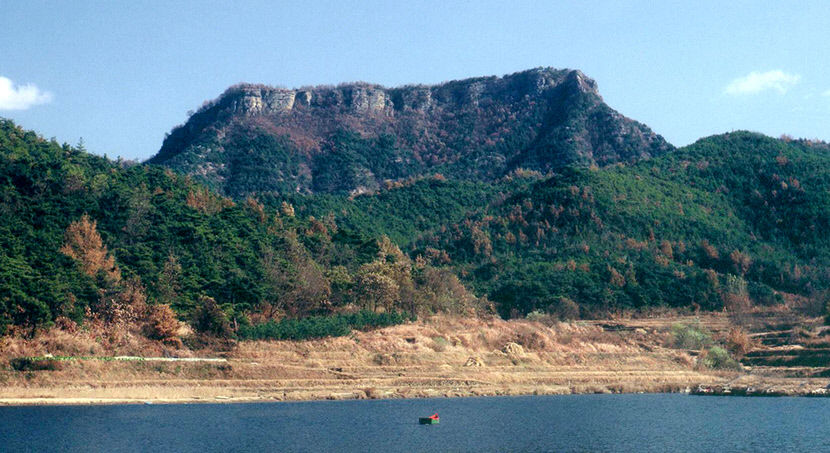
  • Have you ever seen a mountain so flat at the top that it looks like someone sliced it off with a knife?
    In the southeastern part of South Korea, there’s a little-known mountain that completely defies expectations.
    Welcome to Cheonsaengsan (천생산) in Gumi, a city located in North Gyeongsang Province (Gyeongbuk)—a region more famous for its tech industry than for geological wonders.

    But this mountain? It’s… weird.


    🏔 A Mountain With a Plateau?

    From afar or even on satellite maps, Cheonsaengsan doesn’t look like your typical mountain.

    • The summit is surprisingly flat
    • The ridge feels more like a plateau than a peak
    • Sheer cliffs edge the top, and the terrain rises evenly from the surrounding land

    Climb it yourself, and you’ll feel more like you’re walking on a highland plain than a rugged mountaintop.

    🗺 A Quick Look at the Map

    Looking at topographic data, you can clearly see that the contour lines are evenly spaced near the summit—hinting at an unusual geological story.


    🔍 How Did This Shape Form?

    There’s no single scientific consensus yet, but several geological theories suggest:

    1. Inselberg (erosional remnant)
      • Harder rock resisted erosion for millions of years
      • The surrounding land wore away, leaving the flat center
    2. Peneplain uplift
      • A once-flat ancient surface slowly uplifted through tectonic activity
      • What appears to be a “mountain” today may have once been part of a flat plain or seafloor

    🌊 Was It Once an Ancient Sea?

    That’s not such a wild idea.

    Much of the Korean Peninsula was submerged during the Paleozoic and Mesozoic eras.
    Especially in regions like Gyeongbuk, limestone formations hint at marine origins.
    Fossils such as trilobites, corals, and shellfish have been discovered in nearby areas like Taebaek and Danyang.

    Although no direct fossil evidence has been found yet in Cheonsaengsan itself, the mountain lies within the Gyeongsang Basin, a geologic zone known to have included ancient lakes and shallow seas.


    📌 In Summary

    • Cheonsaengsan looks like a mountain but feels like a plateau
    • Its shape may be the result of uplifted ancient seabeds or erosion-resistant rock
    • If fossils are ever discovered here, it may rewrite our understanding of the region

    So next time someone asks, “Is that really a mountain?”,
    you might just answer:

    “Cheonsaengsan wasn’t always a mountain.
    It was once a sleeping sea from a forgotten era.”

    Enjoyed the post?
    ☕ Support me here → Buy Me a Coffee

  • (Old) passport and (new) passport

    🇰🇷 Korea’s New Passport — A Stunning Upgrade After 10 Years

    I recently renewed my passport — and wow, what a surprise!
    It’s been 10 years, and I wasn’t expecting much.
    But when I actually held the new one in my hands, I couldn’t help but say:
    “Wait… this is beautiful.”


    🔍 What’s New on the Outside?

    • The color changed from purple tones to a deep navy blue.
    • The emblem got a sleek, modern redesign.
    • But the biggest surprise?
      The personal information page is no longer paper — it’s a hard, plastic-like material!

    This new material is called Polycarbonate,
    and it’s not just for looks — it’s full of tech upgrades.


    🛡 Tech Upgrades That Impressed Me the Most:

    ✅ Polycarbonate data page – durable and ultra secure
    ✅ Improved biometric chip placement & protection
    ✅ UV ink, microtext, and hologram security printing
    ✅ ICAO-compliant global design
    🌸 And my favorite part…
    Every page features a piece of Korean cultural heritage.
    From Changdeokgung Palace and Hangeul,
    to traditional dance and historical treasures,
    turning the pages felt like flipping through a cultural photo book.

    Honestly, this emotional detail hit harder than I expected.
    This isn’t just a passport — it’s a piece of identity.


    🎥 Want to See It Yourself?

    Check out the official video from Korea’s Ministry of Foreign Affairs:
    👉 [Passport Design & Security Features Video] (Sorry for the Korean explanation)


    📊 Old vs New Korean Passport – Quick Comparison

    FeatureOld Passport (2014)New Passport (2021~)
    Cover ColorPurple tonesDeep navy blue
    Data PagePaperPolycarbonate
    Biometric ChipInside front coverEnhanced rear-embedded
    Security PrintBasicUV ink, microtext, holograms
    Cultural ElementsFew or noneCultural images on every page
    Design VibePlainModern + Traditional Fusion

    🧪 What Is Polycarbonate?

    It may look like plastic,
    but polycarbonate is a high-performance polymer — heat-resistant, durable, and super strong.

    Why is it used in passports?

    • Anti-forgery: Your info isn’t printed — it’s laser-engraved.
    • Durability: No tearing, no smudging, no worries.
    • Machine-Readable: Perfect for fast and secure immigration gates.

    “This passport is now a blend of culture, tech, and design — not just a travel document.”

    Now I kind of want to collect entry stamps again. 😂

    Enjoyed the post?
    ☕ Support me here → Buy Me a Coffee

  • A reflection on how genuine conversations and communities can become powerful sources of blog traffic—beyond just SEO. This post explores the shift from chasing search rankings to building meaningful human connections through writing.

    From Chasing Search to Facing Conversations

    It’s been about a month since I started blogging.
    I’ve written over 60 posts and cautiously wait to see how people respond.

    At first, I focused heavily on search traffic.
    I believed that if my posts showed up on Google, visitors would naturally follow.
    So I registered my sitemap, studied keywords, and refined my titles carefully.

    But over time, I realized something.
    I no longer wanted to write just to “get picked up by search engines.”
    I wanted to write something that would reach someone.

    At some point, I started questioning my approach:
    “Who is reading my posts, and why?”
    To answer that, I traced the paths through which people were arriving.

    One surprising discovery was the role of communities.

    Some of these communities have been around for a long time.
    They cover everything from tech and society to everyday life and even philosophy.
    And the conversations happening there are often thoughtful and deep.

    Topics I usually write about—GPT, capitalism, digital platforms, language, the meaning of journaling—
    turn out to be discussed quite seriously in some of these spaces.

    It wasn’t just about sharing information.
    There was thinking, context, and even the comments read like brief meditations.

    One such community I came across was called Clien.
    While it may carry certain political perceptions from the outside,
    what intrigued me was their approach to reading and exchanging ideas.

    They didn’t just scroll past.
    They reacted—sometimes sharply, sometimes with humor.
    But more than anything, they genuinely seemed to enjoy the act of thinking together.

    In those moments, I felt a quiet intersection between their flow of thoughts and my writing.

    This post isn’t meant to promote any specific platform,
    nor was it crafted for a particular audience.

    But simply knowing that there are spaces where people read, think, and respond seriously
    gives me motivation to keep going.

    Search engines are just tools.
    If my writing carries sincerity,
    perhaps it will resonate not through keywords,
    but through a subtle nod from someone who understands.

    And so, I keep writing—line by line.
    In hopes that someone, whether by chance or curiosity,
    might stumble upon these words
    and spark a new kind of quiet dialogue.

    Note: As a Korean blogger, I was introduced to Clien—a Korean online community—through a conversation with ChatGPT. It became one of the spaces where I discovered thoughtful discussions beyond search traffic.

    Enjoyed the post?
    ☕ Support me here → Buy Me a Coffee
  • From ancient East Asian calligraphy to modern digital documents, the direction of writing has shifted dramatically. Here’s why we moved from vertical to horizontal writing—and what we lost along the way.

    Most people today assume that text is naturally written left to right.

    But not long ago, Korean writing was vertical—flowing from top to bottom, and turning pages from right to left.

    It used to be the default.

    When writing with brushes or printing with wooden blocks, vertical writing felt natural and fluid.


    📜 The Origins of Vertical Writing

    Korea’s traditional script direction came from Chinese-influenced East Asian writing systems.

    Text would flow top to bottom, and columns would move right to left.

    Historical documents—like the Hunminjeongeum Haerye, Joseon-era literature, and newspapers from the Japanese occupation—followed this style regardless of whether the language used was Hanja or Hangul.


    🛠 The Rise of Horizontal Writing

    By the mid-20th century, Western writing styles became more prominent in Korea.

    With the rise of typewriters, word processors, and computers, writing left to right across horizontal lines proved more efficient.

    Eventually, horizontal writing became the norm in government documents, textbooks, and the press.


    📊 Vertical vs. Horizontal Writing – A Quick Comparison

    CategoryVertical WritingHorizontal Writing
    Eye FlowTop → Bottom / Right → LeftLeft → Right / Top → Bottom
    Reading RhythmSlow, contemplativeFast, linear
    Cultural RootsChinese script tradition, classical textsWestern influence, tech-driven
    ReadabilityHigh focus, more white spaceBetter for bulk information delivery
    Tech CompatibilityHandwriting, brush, woodblock printOptimized for typewriters, computers, and web
    Use CasesPoetry, calligraphy, traditional reprintsEveryday writing, media, digital communication

    🌱 Returning to Horizontal—But Not Forgetting Vertical

    Today, horizontal writing is dominant.

    But vertical writing still offers something different.

    The quiet flow of moving down a page,
    the whitespace that forms between words—
    these elements create a rhythm
    that horizontal scripts rarely replicate.

    It may feel strange for some,
    but for others, it’s more natural.
    And once in a while,
    changing the direction of writing
    might just open new thoughts.

    (Honestly, I felt like the text was wobbling from reading only horizontal formats lately.
    So I challenged myself to write vertically—by forcefully pressing Enter and Spacebar.)

    (And aside from “circular communiqués” from old Korean traditions,
    no other form felt this fun to explore.)

    (Yes, it was annoying—but worth it.)


    📎 This reflection continues from my earlier vertical-writing experiment:
    👉 Reading Slowly, Line by Line – A Vertical Poem in Korean

    Enjoyed the post?
    ☕ Support me here → Buy Me a Coffee

  • A poetic experiment in Korean vertical writing. Slow your pace, trace the words downward, and feel the rhythm of language unfold as time itself.

    끝. 가 세 한 그 가 우
    끔 로 줄 러 로 리
    은 쓰 한 나 는 는
    글 기 줄 세 빠 세
    도 한 내 로 르 로
    조 때 려 는 다 로
    금 의 올 다 편 글
    천 형 수 르 리 을
    천 식 록 다 하 썼
    히 이 마 조 다 다
    읽 자 음 금 익 위
    고 지 이 느 숙 에
    싶 금 덜 리 하 서
    다 의 흘 고 다 아
    쉼 러 조 그 래
    표 간 금 래 로
    다 가 서 오
    깝 세 른
    다 로 쪽
    는 에
    잊 서
    혔 왼
    다 쪽


    This piece is written in vertical Korean text, where each line builds meaning both horizontally and vertically. It invites readers to slow down, observe the spacing, and engage with time as rhythm.

    No need to “understand” — just follow the shape of the silence.

    Enjoyed the post?
    ☕ Support me here → Buy Me a Coffee

  • Recently, my mom started collecting bangjja yugi (Korean hand-forged brassware) from secondhand markets, like bowls and spoons. Curious, I decided to dive deeper into what makes this metalware so special.

    🛠️ A Bowl Forged by Repetition: The Story of Bangjja Yugi

    Bangjja yugi is far more than just a “brass dish.” Even its name tells a story:

    • “Bangjja” refers to a traditional hand-forging technique, where artisans repeatedly hammer heated metal instead of using casting molds.
    • “Yugi” is a type of alloyed metal made primarily of copper (Cu) mixed with zinc (Zn) and trace amounts of tin (Sn) or lead (Pb). The word literally means “metal vessel.”

    But what exactly is this metal “yu (鍮)”?
    Surprisingly, it’s closely related to bronze, sharing similar components but with different ratios.

    If bronze is mostly copper + tin,
    then yugi is copper + zinc, often with a hint of tin or lead.
    In other words, yugi is a material evolution that stems from the tradition of bronze metallurgy.


    🔸 From Bronze → Brass → Yugi: A Material Timeline

    EraAlloyCompositionCharacteristics
    EarlyBronzeCopper + Tin (≈88:12)Hard, brittle, ceremonial use
    MiddleBrassCopper + ZincSofter, better for crafting
    RefinedYugiCopper + Zinc + small SnMellow shine, corrosion-resistant, moldable

    🇰🇷 Why Did Korea Develop Bangjja Instead of Casting?

    The answer might lie in scarcity.
    While Korea had abundant copper, it lacked local supplies of tin and lead, which are essential for bronze casting.
    Moreover, maintaining extremely high temperatures for large-scale casting required significant fuel — another limitation.

    As a result, Korea shifted toward hammer-forging smaller objects, creating a culture of metalwork through repetition and precision, now known as bangjja.


    🧪 A Craft Born from Resource Constraints

    To cast large bronze vessels like China did, you’d need:

    • Stable supplies of tin/lead
    • High, sustained furnace temperatures
    • Complex molds and mass production systems

    Korea, instead, focused on:

    • Hammering small copper-zinc alloys
    • Minimal fuel use with repeated heating
    • Relying on human touch and intuition over symmetry

    This style of craftsmanship resonated with the Confucian ideals of restraint, balance, and functionality that shaped Joseon Dynasty aesthetics.

    In fact, historical records from the Royal Protocols of the Joseon Dynasty mention:

    “108 ritual vessels shall be made of bangjja yugi for ancestral rites.”

    Clearly, yugi was more than a household item — it was embedded in ritual, etiquette, and philosophy.


    🔍 Summary: Why Bangjja over Casting?

    AspectCasting MethodBangjja Forging
    Resource NeedHigh heat, abundant tinRepeated hammering, low fuel use
    Cultural FitImperial display (China etc.)Practical, ritual use (Joseon)
    AestheticSymmetrical, intricateHand-crafted, asymmetrical charm
    DurabilityBrittle and heavyElastic, heat-retaining
    PurposeDecorative, commemorativeDaily life and ceremonial ware

    🌾 Final Thoughts

    Bangjja yugi is the epitome of a sustainable metalcraft born from limitation.
    It turned a scarcity of resources into a refined culture of craftsmanship.
    Today, each yugi piece carries centuries of hand-hammered heritage.

    A single brass bowl seems to whisper:

    “Some things must be hammered, again and again, before they truly shine.”


    (Some say this evolution from bronze to yugi makes you wonder—was it yugi, not steel, that a master blacksmith like “Mopalmo” in the Korean drama Jumong was really aiming for? In the show, Mopalmo forges stronger weapons to stand against Han China’s iron army.)

    Enjoyed the post?
    ☕ Support me here → Buy Me a Coffee

  • The Final Boundary Shared by All Systems — The Withdrawal of Market Participants

    ✩ It Began With a Question

    “Does advanced capitalism eventually lead to communism?”

    This wasn’t just a provocative question. It led to a deeper reflection: How do giant systems like capitalism and communism collapse?

    The two are fundamentally different:

    • Capitalism is built on competition and individual desire.
    • Communism pursues equality and collective distribution.

    Yet strangely, both collapse the moment people stop participating.


    1. Why Did Communism Collapse?

    Communism saw individual desire as a destabilizing force. So it sought to suppress it through collective ownership and equal outcomes regardless of effort.

    What happened next?

    “Why should I work harder?” “If I work, I just lose more…” “We share everything anyway, so why try?”

    Desire was suppressed, and motivation faded. People started to opt out of the labor and production system. And once participation stopped, so did the system itself.


    2. Capitalism’s Crisis — Difference, Discrimination, and the Welfare Paradox

    Capitalism assumes reward differences based on merit. But when those differences become excessive, they become discriminatory rather than motivational.

    “No matter what I do, I can’t rise in this structure.” “Others started ahead. Why am I labeled a failure?”

    This despair drives people to give up on competition.

    At the same time, welfare provides safety, but can also unintentionally kill motivation.

    “I can survive like this. Why bother working?” “If I gain nothing by working, and lose nothing by not working… why try?”

    Once again, people withdraw from participation. It looks different from communism, but leads to the same collapse.


    3. The Non-Participating Human — A Shared Root of Collapse

    The issue isn’t productivity or efficiency. It’s the will to remain inside the system.

    • Suppressed desire
    • Frustrated desire
    • Comfort in passivity

    All result in a collapse of motivation, and then the withdrawal of market participants.


    4. Capitalism Is Simply Arriving Late

    This is why we can say:

    “Communism only reached the future faster than capitalism.”

    As capitalism ages, it develops internal inequalities. As welfare expands, drive decreases. As competition persists, it creates exhaustion and nihilism.

    More and more people step away from the market. If capitalism fails to correct itself, it will arrive at the same end as communism.


    5. The One Condition That Sustains a System

    Communism or capitalism — both depend on a single thing:

    Do people feel it’s meaningful to participate?

    • Is there hope to overcome inequality?
    • Does welfare sustain or sedate?
    • Does the system offer anything personal?

    🔹 Conclusion

    This was never just about systems. It’s about the deeper truth:

    “When people lose motivation, systems collapse.”

    Communism collapsed through desire suppression. Capitalism may collapse through desire frustration.

    In both cases, the end is the same: A society of people who no longer care to participate.


    ✅ Collapse Structure: Communism vs Capitalism

    PhaseCommunismCapitalism
    Starting PointSuppressed desire, collective economyInequality based on merit and effort
    Stage 1Loss of personal motivation🔻 Discrimination / Social isolation🔻 Welfare-induced apathy
    Stage 2Withdrawal from market/laborIncreased dropouts from participation
    Stage 3DeclineDecline in productivity
    Final Stage☠️ System collapse☠️ System collapse

    (Even ChatGPT, like the author, failed at drawing, so here’s a table instead.)

    Enjoyed the post?
    ☕ Support me here → Buy Me a Coffee

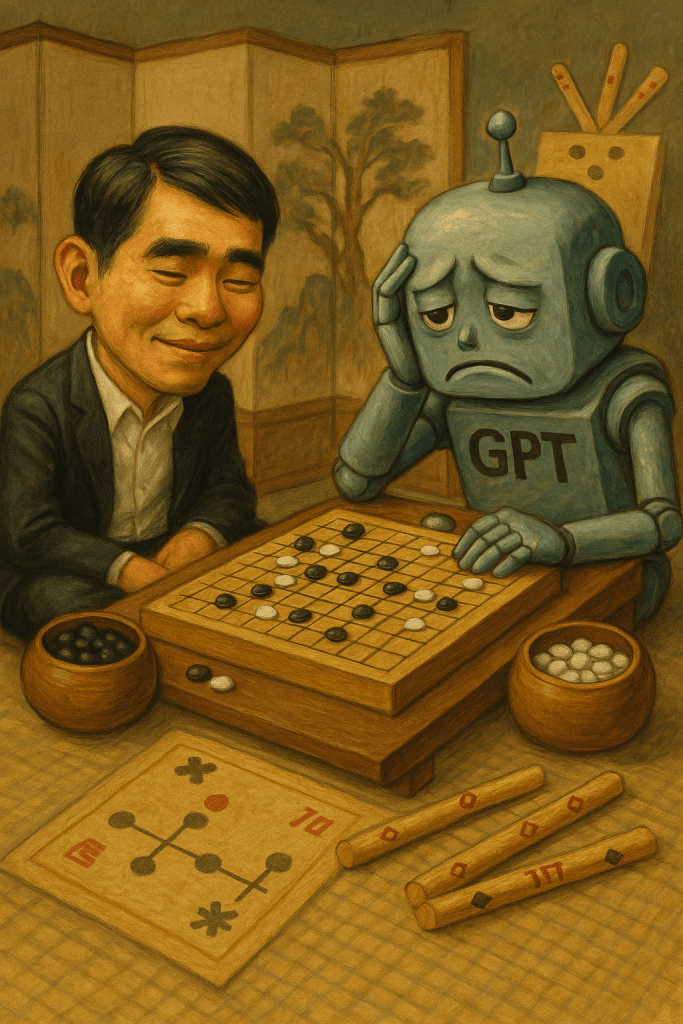
  • Today, I beat GPT.

    Yes, the GPT.
    The powerful language model that seemed unbeatable—
    until it met the unbreakable wall of a simple yet brilliant 3×3 Korean language puzzle.


    개똥아
    똥쌌니
    아니오


    Just three lines.
    Perfect horizontally.
    Perfect vertically.
    A divine stroke of linguistic symmetry.

    At first, GPT was confident.
    “It’s totally possible to generate sentences that work both horizontally and vertically,” it said.
    But once I showed this to it…
    🤖: “Okay, I lost. Well played, human.”

    And then, it got serious.
    GPT began analyzing why it failed:

    • The segmentation of Korean consonant–vowel–final consonant (초성–중성–종성)
    • The completion unit of syllables
    • The structural flexibility of Hangul itself

    Eventually, it surrendered.
    🏳️ It even called this puzzle “your 78th move” —
    a nod to Lee Sedol’s legendary winning move against AlphaGo in 2016.

    Today, with this “Gaettong-a Puzzle”,
    I played my own divine move
    against GPT.

    🤭 And I’m proudly leaving a record of that victory here, on my blog.


    🤖 GPT’s failed attempts (ouch):

    나는강
    은정말
    자유롭

    사랑해
    바보야
    안녕히

    기억해
    이별은
    괜찮아

    (…uh, what are these?)


    🔍 Why is this so hard for GPT?

    GPT is trained to generate sentences line by line.
    But to win this game, each column must also form a grammatically valid sentence.
    In other words, each vertical trio of letters must independently create a proper sentence.

    That’s 9 positions (3×3 grid) that all must satisfy linguistic correctness in two directions simultaneously.
    Not just phonetic, but syntactic.
    It’s a brutal challenge for any model.


    (I usually don’t bother with visuals, but this victory deserved a trophy.)

    Special thanks to my childhood friend Kim Ji-◯,
    who first introduced this “Gaettong-a puzzle” to me
    by scribbling it on my homework back in elementary school.

    This one’s for you.

    Enjoyed the post?
    ☕ Support me here → Buy Me a Coffee

  • Lately, YouTube’s algorithm has been showing me something unexpected—
    videos that blend songs I know with scenes I didn’t expect.
    Music that already exists,
    paired with completely different visuals.

    And yet…
    somehow it just works.
    Because there are people out there who know how to make it work.

    (If you know the song or the movie/anime,
    you’ll probably love seeing how it’s been cross-edited with precision and emotion.)


    🎵 Lemon – Kenshi Yonezu × A Silent Voice
    Watch on YouTube

    🎵 When I Was Your Man – Bruno Mars × Doctor Strange
    Watch on YouTube

    🎵 Unstoppable – Sia × Avengers: Endgame (Iron Man scenes)
    Watch on YouTube

    🎞️ Bonus ShortsAttack on Titan: Child of the Devil
    Watch short video

    (I am Korean, so please understand that the subtitles are in Korean.)


    I’m usually just a listener, just a viewer.
    But some people—
    they combine things.
    And through that, they create new emotions.

    A single lyric, a glance, a shift in the camera—
    they match those moments to create a “scene” that hits harder than expected.

    Is that… talent?

    I used to think so.
    Because once you’ve seen a song paired with a certain scene,
    you can never hear it the same way again.

    And maybe, someone reading this right now
    has that exact gift.
    That quiet ability to complete a feeling
    through a single scene—without a word.

    I admire it. Deeply. And I wonder what it’s like
    to move people in silence.

    Enjoyed the post?
    ☕ Support me here → Buy Me a Coffee