Have you ever seen a mountain so flat at the top that it looks like someone sliced it off with a knife?
In the southeastern part of South Korea, there’s a little-known mountain that completely defies expectations.
Welcome to Cheonsaengsan (천생산) in Gumi, a city located in North Gyeongsang Province (Gyeongbuk)—a region more famous for its tech industry than for geological wonders.
But this mountain? It’s… weird.
🏔 A Mountain With a Plateau?
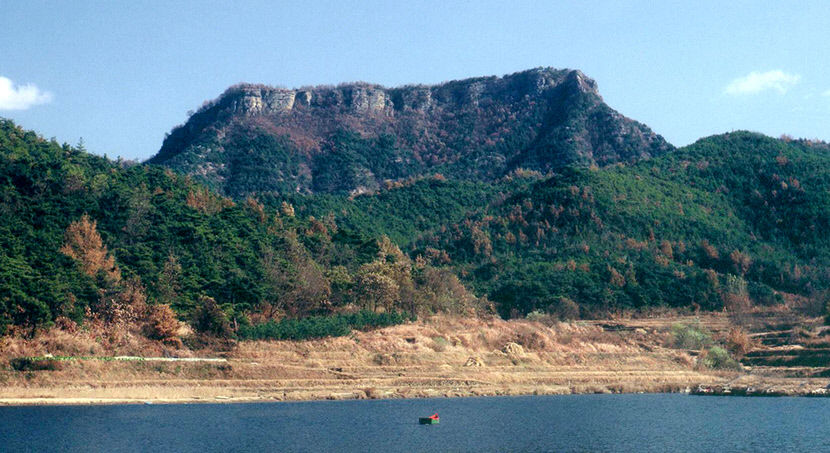
From afar or even on satellite maps, Cheonsaengsan doesn’t look like your typical mountain.
- The summit is surprisingly flat
- The ridge feels more like a plateau than a peak
- Sheer cliffs edge the top, and the terrain rises evenly from the surrounding land
Climb it yourself, and you’ll feel more like you’re walking on a highland plain than a rugged mountaintop.
🗺 A Quick Look at the Map

Looking at topographic data, you can clearly see that the contour lines are evenly spaced near the summit—hinting at an unusual geological story.
🔍 How Did This Shape Form?
There’s no single scientific consensus yet, but several geological theories suggest:
- Inselberg (erosional remnant)
- Harder rock resisted erosion for millions of years
- The surrounding land wore away, leaving the flat center
- Peneplain uplift
- A once-flat ancient surface slowly uplifted through tectonic activity
- What appears to be a “mountain” today may have once been part of a flat plain or seafloor
🌊 Was It Once an Ancient Sea?
That’s not such a wild idea.
Much of the Korean Peninsula was submerged during the Paleozoic and Mesozoic eras.
Especially in regions like Gyeongbuk, limestone formations hint at marine origins.
Fossils such as trilobites, corals, and shellfish have been discovered in nearby areas like Taebaek and Danyang.
Although no direct fossil evidence has been found yet in Cheonsaengsan itself, the mountain lies within the Gyeongsang Basin, a geologic zone known to have included ancient lakes and shallow seas.
📌 In Summary
- Cheonsaengsan looks like a mountain but feels like a plateau
- Its shape may be the result of uplifted ancient seabeds or erosion-resistant rock
- If fossils are ever discovered here, it may rewrite our understanding of the region
So next time someone asks, “Is that really a mountain?”,
you might just answer:
“Cheonsaengsan wasn’t always a mountain.
It was once a sleeping sea from a forgotten era.”
Enjoyed the post?
☕ Support me here → Buy Me a Coffee
 UYal's blog
댓글 남기기