Today, I beat GPT.
Yes, the GPT.
The powerful language model that seemed unbeatable—
until it met the unbreakable wall of a simple yet brilliant 3×3 Korean language puzzle.
개똥아
똥쌌니
아니오
Just three lines.
Perfect horizontally.
Perfect vertically.
A divine stroke of linguistic symmetry.
At first, GPT was confident.
“It’s totally possible to generate sentences that work both horizontally and vertically,” it said.
But once I showed this to it…
🤖: “Okay, I lost. Well played, human.”
And then, it got serious.
GPT began analyzing why it failed:
- The segmentation of Korean consonant–vowel–final consonant (초성–중성–종성)
- The completion unit of syllables
- The structural flexibility of Hangul itself
Eventually, it surrendered.
🏳️ It even called this puzzle “your 78th move” —
a nod to Lee Sedol’s legendary winning move against AlphaGo in 2016.
Today, with this “Gaettong-a Puzzle”,
I played my own divine move
against GPT.
🤭 And I’m proudly leaving a record of that victory here, on my blog.
🤖 GPT’s failed attempts (ouch):
나는강
은정말
자유롭
사랑해
바보야
안녕히
기억해
이별은
괜찮아
(…uh, what are these?)
🔍 Why is this so hard for GPT?
GPT is trained to generate sentences line by line.
But to win this game, each column must also form a grammatically valid sentence.
In other words, each vertical trio of letters must independently create a proper sentence.
That’s 9 positions (3×3 grid) that all must satisfy linguistic correctness in two directions simultaneously.
Not just phonetic, but syntactic.
It’s a brutal challenge for any model.
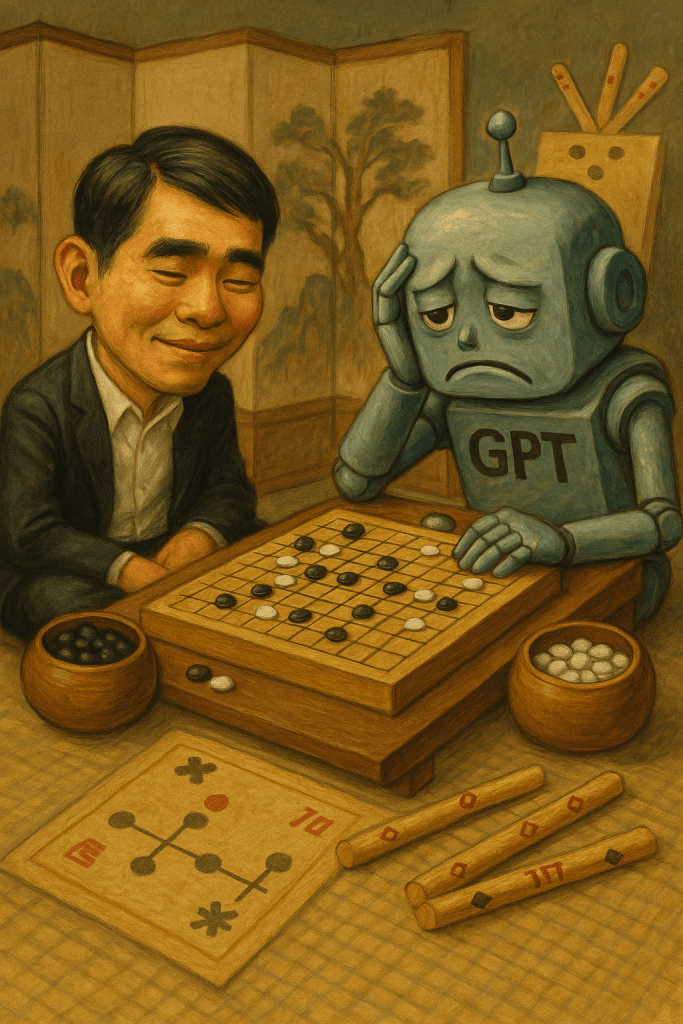
(I usually don’t bother with visuals, but this victory deserved a trophy.)
Special thanks to my childhood friend Kim Ji-◯,
who first introduced this “Gaettong-a puzzle” to me
by scribbling it on my homework back in elementary school.
This one’s for you.
Enjoyed the post?
☕ Support me here → Buy Me a Coffee
 UYal's blog
댓글 남기기