I’ve always admired Chinese history—its grandeur, complexity, and the cultural continuity spanning millennia.
But admiration doesn’t mean turning a blind eye to contradictions.
At the center of this complexity stands the Great Wall, and at its easternmost edge lies the Shanhaiguan Pass—the so-called “First Gate Under Heaven.”
🏯 Shanhaiguan – Where the Wall Begins, and Civilizations Diverge
Located in northeastern Hebei Province, near Qinhuangdao City,
Shanhaiguan marks the starting point of the Great Wall of China.
Above its gate, the characters “天下第一關” are inscribed:
“The First Gate Under Heaven.”
To the Han Chinese, this was the threshold of civilization.
To northern tribes, it was the entrance to a realm both admired and opposed.
A place where flatlands meet—a strategic chokepoint not only for armies,
but for the very idea of who belongs inside and who stays out.
🧭 Geography Carved Civilization – Inside and Outside the Wall
Ancient Chinese civilization was defined not only by rivers and dynasties,
but by the terrain that shaped its boundaries.
- Inside the Wall: fertile plains and rivers → agrarian Han culture
- Outside the Wall: mountains and steppes → nomadic and hunting cultures
This natural divide became a cultural one.
Those beyond the Wall were called Dongyi, or “eastern barbarians.”
Among them were the ancestors of the Korean people:
the Yemaek, Malgal, and Jurchen tribes.
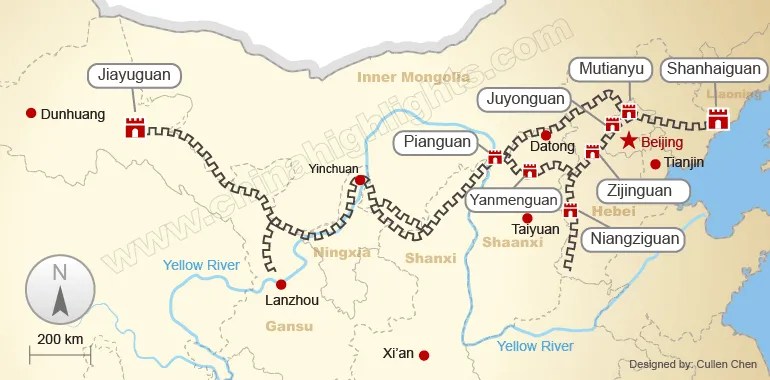
The Great Wall and Shanhaiguan on the far right
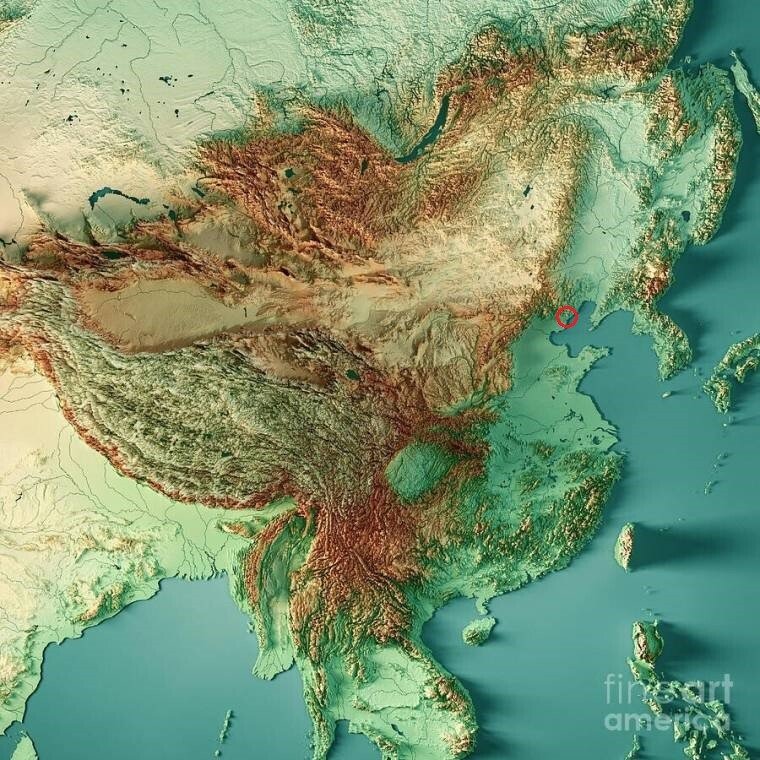
Shanhaiguan (red circle) where two huge plains connect / The green circle in the middle of the map is the Sichuan Basin where Liu Bei’s Shu Kingdom was located
🐉 Chiyou vs. the Yellow Emperor – A Mythic Divide
In Chinese legend, Chiyou, a warrior-king of the eastern tribes,
waged a great war against the Yellow Emperor, the forefather of the Han.
More than a myth, it reflects a real tension:
a power struggle between civilizations—not just nations.
Koreans never referred to our ancient kings as Emperors.
We called them Heavenly Kings, descendants of Chiyou.
This distinction matters—it speaks to differing origins of authority and worldview.
🐚 Forgotten Civilization in the Liao River Basin – Hongshan Culture
Outside the Wall, in the Liao River basin, lies one of the most ancient cultures discovered in East Asia:
the Hongshan Culture (紅山文化)—predating the Yellow River civilizations.
With its goddess statues, jade artifacts, bear totems, and tiered altar-shrine-tomb complexes,
Hongshan culture resonates deeply with Korean foundational myths, such as Dangun.
While modern China claims Hongshan as part of its history,
its cultural legacy is more visible and alive in Korea.
Culture survives through memory and practice—not land alone.
The true inheritor is the one who remembers.
🕊️ Boundaries and Fusion – What the Gate Divides, and What It Opens
Geography sets borders.
But borders can divide—or connect.
If China claims to embrace the histories of the Manchu, Mongols, or Tibetans,
then it must also acknowledge the legitimacy of their cultural trajectories.
And if it insists on seeing history only through the lens of the Han majority,
then its grand multicultural narrative begins to collapse.
I respect Chinese culture, deeply.
But I also wish to view it with fairness, clarity, and context.
Not through forceful inclusion or exclusion,
but by asking:
“What did the First Gate under Heaven really keep out—and what did it let in?”
That single question invites us to rethink
the flow of geography, civilization, and memory.
Enjoyed the post?
☕ Support me here → Buy Me a Coffee
 UYal's blog
댓글 남기기