“Do you know about Goguryeo’s Cheolli Jangseong?”
When I asked ChatGPT, it confidently answered:
“It’s a wall stretching from the Chongchon River to the Amnok River.”
But wait—
That’s Goryeo’s wall, not Goguryeo’s.
The Name We Forgot to Remember
Most people, when they hear Cheolli Jangseong (천리장성, “Thousand-Li Wall”), instantly think of Goryeo, not Goguryeo.
But historically, Goguryeo also built a thousand-li long fortification,
stretching from Biseong Fortress (near modern-day Dalian, China) to Yodong Fortress (Liaoyang area),
hugging the ridgelines of Manchuria’s rugged terrain.
Below these mountain ridges lie the vast and fertile plains of Songhua and Liao Rivers—
a perfect base for supply and defense.
The wall wasn’t just defense—it was a geostrategic masterpiece.
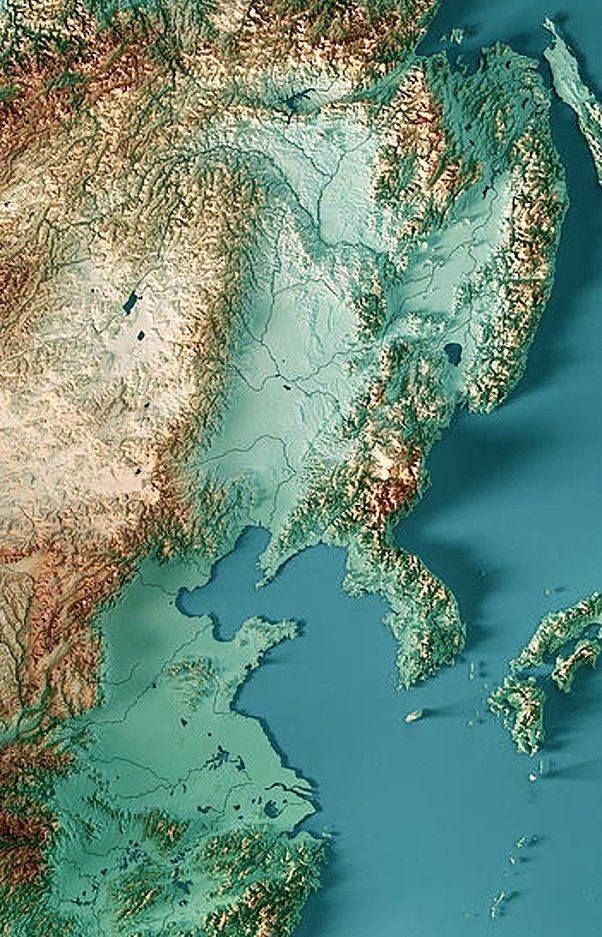
A topographical map of Manchuria with added three-dimensionality.
Goguryeo’s Great Wall of China (red) and Goryeo’s Great Wall of China (blue)

A Map That Finally Made Sense
Here’s the kind of map I was hoping for—
terrain color-coded with elevation,
revealing why the plains of Manchuria are called “plains” at all.
As a kid who obsessed over social studies atlases,
I couldn’t help staring at it for a while.
🤖 AI Gets It Wrong (and That’s the Point)
Why did ChatGPT give the wrong answer?
Because nobody really talks about Goguryeo’s wall.
It’s hardly mentioned in textbooks, search engines, or popular content.
Even AI learned to forget what we forgot.
It was a minor moment, but telling:
I asked for a Manchurian topographic map, and it offered a version labeled “Sea of Japan”
—which any Korean would find problematic, since we refer to it as “East Sea” due to long-standing naming disputes.
🏞️ Where Mountains Defended and Plains Sustained
The Cheolli Jangseong began near modern-day Dalian (Biseong Fortress),
traced the mountain spines,
and stretched all the way to the Yodong area, deep within Liaoning Province.
Looking at topographic maps,
you can clearly see that it was not just a wall,
but a natural border—leveraging ridges and valleys for defense,
while securing the fertile land below for logistics and settlement.
💭 Rethinking Manchuria
Seeing this again, it’s clear why the flatlands of Manchuria were hotly contested.
Controlling the region meant controlling a vast resource base.
Whoever held the plains likely held power.
🕊️ Dalian, and a Poet We All Know
When I saw Dalian on the map, I paused.
That’s where Yun Dong-ju, one of Korea’s most beloved poets,
spent his final days—imprisoned in Lüshun Prison during the Japanese occupation.
His name is etched into every Korean heart,
not just for his verses, but for the quiet resistance they embodied.
How haunting, then,
that the city marking the start of Goguryeo’s ancient wall
is also where a modern symbol of Korean resistance passed away.
The wall and the prison.
Stone and soul.
Past and present resistance—intertwined in one forgotten place.
 UYal's blog
댓글 남기기