We live in a three-dimensional world.
The X, Y, and Z axes.
Everything we see and touch exists on this grid,
and we call it reality.
But what if we extend a cube one more step?
A 4-dimensional cube,
known as the 테서랙트 (Tesseract), emerges.
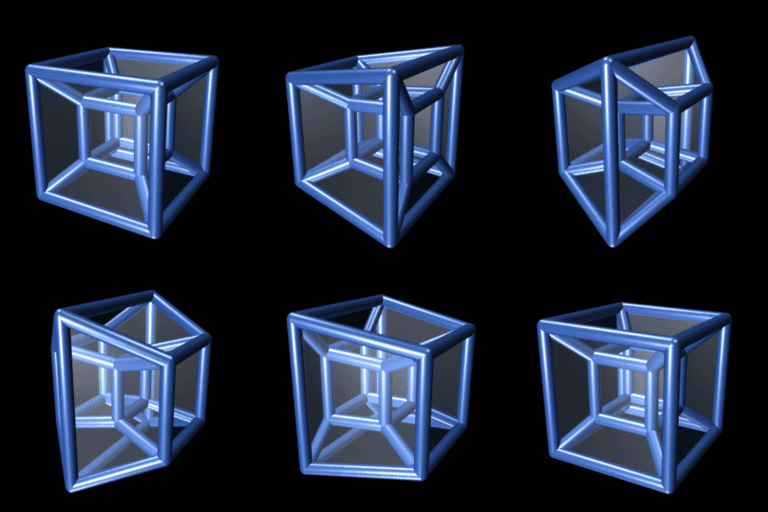
📌 The Tesseract Moves — But Why?
To express the 4th dimension in 3D,
we need to borrow the dimension of time to animate it.
Because we, limited to 3D perception,
cannot observe the 4th dimension in stillness.
This movement isn’t “time” itself—
but it’s only possible because time exists.
So, the visualization of a 테서랙트 relies on the passage of time.
Its rotation reflects the multi-directionality of 4D structure across time.
📌 But What If Time Itself Warps?
In space, time doesn’t always flow evenly.
Think: black holes.
At their core, gravity becomes so intense
that time slows down—or even comes to a stop.
At this point, we go beyond 4D into something else entirely.
That warped spacetime?
We call that the 5th dimension.
📌 We See Only the Shadows
This is where philosophy steps in.
Plato once said:
“What we see is only the shadow of reality.”
Just like his Allegory of the Cave,
we might be watching distorted shadows of higher dimensions on the walls of our reality.
Perhaps the 테서랙트 is not the shape itself,
but rather the projection of a 4D object onto our 3D world—
the shadow of something more real.
📌 TL;DR – In 우얄 Style
- The 테서랙트 is a visualization of the 4th dimension.
- We perceive its movement only through time.
- When time itself warps, like near a black hole,
we get a glimpse into a 5D world. - This all points back to Plato:
Maybe we’re only watching the shadow of what’s real.
And as always, in true 우얄 fashion:
“If I dig any deeper… a UFO might come to take me away 👽”
Enjoyed the post?
☕ Support me here → Buy Me a Coffee
 UYal's blog
댓글 남기기